
-
YOGAYOGA
-
FITNESSFITNESS
-
PERSONAL TRAININGPERSONAL TRAINING
-
JOIN USJOIN US
-
HAPPENINGSHAPPENINGS
You finish a hard session, shake up a protein drink, and feel like you have done everything right. Recovery handled. But if that shake is the beginning and end of your post-workout nutrition strategy, you are only covering half the picture, and that gap is quietly limiting everything you are working towards in the gym.
Post-workout nutrition is not complicated, but it is widely misunderstood. Most people fixate on protein while overlooking the other pieces that determine how well the body actually recovers. This is the practical, no-fluff guide on what to eat after a workout for recovery. Not just muscle repair, but restored performance, reduced soreness, and the ability to show up and train hard again.
The moment a training session ends, the body begins a complex repair process: Muscle fibres that were broken down under load need to be rebuilt. Glycogen stores have been depleted and need replenishing. Inflammatory responses triggered by the session are underway. The hormonal environment that supports muscle protein synthesis is primed and ready. What you eat in the period after a workout directly influences how efficiently all of that happens. The right nutrients accelerate repair, reduce the duration of soreness, and restore fuel reserves. Get that right, and you recover faster. Neglect it, and the body has to work harder with fewer resources. This is not a concern exclusive to competitive athletes. Anyone who holds a gym membership in Singapore and trains with regularity and intention, whether that is three sessions a week or six, is putting consistent demand on the body. Consistent demand requires consistent support.
Post-recovery workout recovery nutrition rests on three macronutrient pillars, and each one plays a distinct role in the process:
Protein: Provides the amino acids required to repair and rebuild damaged muscle tissue.
Carbohydrates: Replenish glycogen stores and support the hormonal response that drives recovery.
Fats: While less urgent in the immediate post-workout window, they contribute to managing inflammation and supporting the longer-term cellular repair process.
The mistake many gym-goers make is avoiding carbohydrates in their meals post-workout out of concern for fat loss. It is an understandable instinct, but a counterproductive one. Post-workout carbohydrates are preferentially used to restore glycogen rather than stored as fat, as the metabolic context is fundamentally different from eating carbohydrates at rest.
Research consistently points to a post-workout protein intake of around 20 to 40 grams as the effective range for stimulating muscle protein synthesis. Beyond that, the additional protein offers diminishing returns, as the body has a limit to how much it can utilise for muscle repair in a single sitting. More is not always better, and a post-workout recovery meal does not need to be a protein overload to be effective. Whole food sources, including grilled chicken, eggs, salmon, Greek yoghurt, cottage cheese, or legumes for plant-based options, deliver protein alongside micronutrients that supplements cannot replicate. While eating enough protein during your post-out workout recovery meal can be helpful, it is better to ensure you are eating enough protein overall instead of trying to fit it into a very specific window. Active individuals should generally aim for 1.2g to 2.2g of protein per kg of bodyweight.
Glycogen is stored carbohydrate energy. During training, particularly strength work or high-intensity cardio, it is the body’s preferred fuel source. After a demanding session, those stores can be substantially or fully depleted depending on duration and intensity. Pairing protein with quality carbohydrates after training supports both glycogen replenishment and the uptake of amino acids into muscle tissue. Good options include:
These are foods that digest efficiently and deliver glucose to the muscles without unnecessary processing. Carbohydrate needs are not one-size-fits-all. A 45-minute moderate-intensity session requires less glycogen restoration than a 90-minute strength and conditioning workout. Adjusting carbohydrate intake to the demands of the session is a smarter approach than applying a fixed formula regardless of effort.
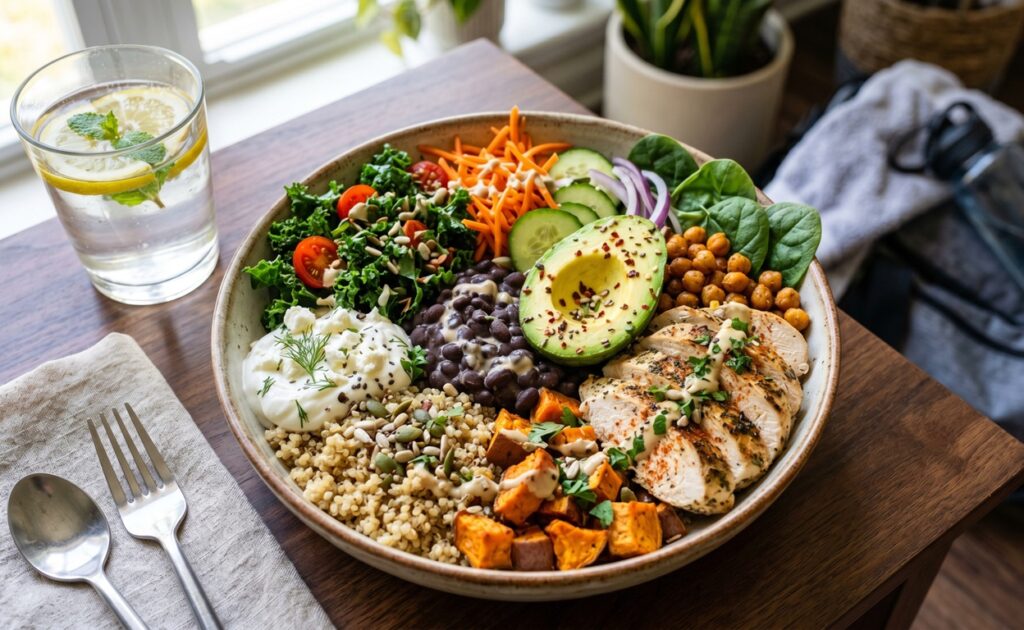
A whole-food post-workout meal that balances protein and carbohydrates will outperform a supplement-heavy approach in most recovery contexts. Real food comes with fibre, vitamins, minerals, and compounds that work together in ways no powder formulation fully replicates. Practical meal ideas that hit the right balance include:
These are not complicated meals. They are accessible, effective, and built around the macronutrient ratios that support genuine recovery.
The concept of the “anabolic window,” referring to a narrow period after training where nutrition is considered critical, has been overstated in fitness culture. Research suggests that the window is wider than originally believed, and that total daily nutrient intake is a stronger determinant of recovery and adaptation than eating within a specific number of minutes post-session. That said, eating within one to two hours of training is still a worthwhile habit. The body is in a receptive state, and providing the right nutrients during this period supports the repair process that has already begun. For those who cannot eat immediately after training due to schedule or appetite, a meal within two hours is still well within an effective range.
Under-eating after a workout is one of the most common and costly recovery mistakes. The training session creates the stimulus for adaptation, but without adequate nutrition to support it, that adaptation is limited. Muscle repair stalls, soreness persists longer, and progress slows. Over-reliance on protein supplements compounds the problem. When a shake replaces a balanced meal, carbohydrates, healthy fats, and micronutrients are often sacrificed in the process. The protein target is hit, but the broader nutritional picture is incomplete. Skipping post-workout recovery nutrition entirely, particularly after intense or long sessions, is perhaps the most counterproductive habit of all. It is also surprisingly common among gym-goers managing busy schedules. Planning ahead, even with a simple portable meal, removes this as an obstacle.
Post-workout nutrition is a complete recovery strategy, not a single supplement decision. Protein matters. Carbohydrates matter. Timing, food quality, and total daily intake all contribute to how well and how quickly your body responds to the work you are putting in. But nutrition is only one side of the equation. Pairing smart recovery habits with a results-driven training programme is where genuine results come from. This is where structure and coaching make a significant difference. At PURE, our team of certified personal trainers are equipped to provide optimised, results-driven training programmes to help you build a balanced approach to training, recovery, and performance.The goal is to remove guesswork so every part of your training works with your recovery, not against it. Ready to take both your training and your recovery seriously? Book an introductory session with some of the best personal trainers in Singapore at PURE and get a structured plan built around your goals, your schedule, and how your body performs best.
Whether you want to tone your body or pump up your cardio, harness the power and grit with PURE Fitness.
From private yoga to specialised classes, enjoy the ultimate yoga experience with PURE Yoga and lead happier, healthier, and more balanced lives.

Transform your technique & physique with our dedicated PURE Pilates classes.

From yoga to fitness, PURE Online provides scheduled and on-demand workout videos to practise anytime and anywhere.

noodfood offers only the good stuff — delicious and nutritious food and drinks including cold-pressed juices, raw foods and organic snacks to keep you happy and healthy.
Whether you want to tone your body or pump up your cardio, harness the power and grit with PURE Fitness.
From private yoga to specialised classes, enjoy the ultimate yoga experience with PURE Yoga and lead happier, healthier, and more balanced lives.
Transform your technique & physique with our dedicated PURE Pilates classes.
From yoga to fitness, PURE Online provides scheduled and on-demand workout videos to practise anytime and anywhere.
noodfood offers only the good stuff — delicious and nutritious food and drinks including cold-pressed juices, raw foods and organic snacks to keep you happy and healthy.


